3 hr
Everglades Mangrove Tunnel Kayak Adventure
Glide through sunlit mangrove tunnels and tidal creeks in North America's largest coastal forest
Reserve
Hand-picked by our editors — only the best 5 experiences from 14 reviewed.
Verified partners for every tour, free cancellation where available, and instant confirmation on every booking.
3 hr
Glide through sunlit mangrove tunnels and tidal creeks in North America's largest coastal forest
Reserve
4 hr
Paddle through mangrove tunnels and cypress swamps while a naturalist reveals wildlife secrets
Reserve
1 hr 45 min
Navigate winding waterways through 10,000 islands while spotting dolphins, manatees, and rare birds
ReservePrices from verified partners. Availability updates in real time at checkout. Free cancellation policies apply where shown.
The landmarks, rooms, and views travelers on this tour remember — all visible on a single visit.
Narrow, winding channels created by arching red mangroves that provide shade and habitat
Expansive estuarine environment home to manatees, dolphins, and diverse bird species
Iconic ecosystem of the Everglades visible near many launch points
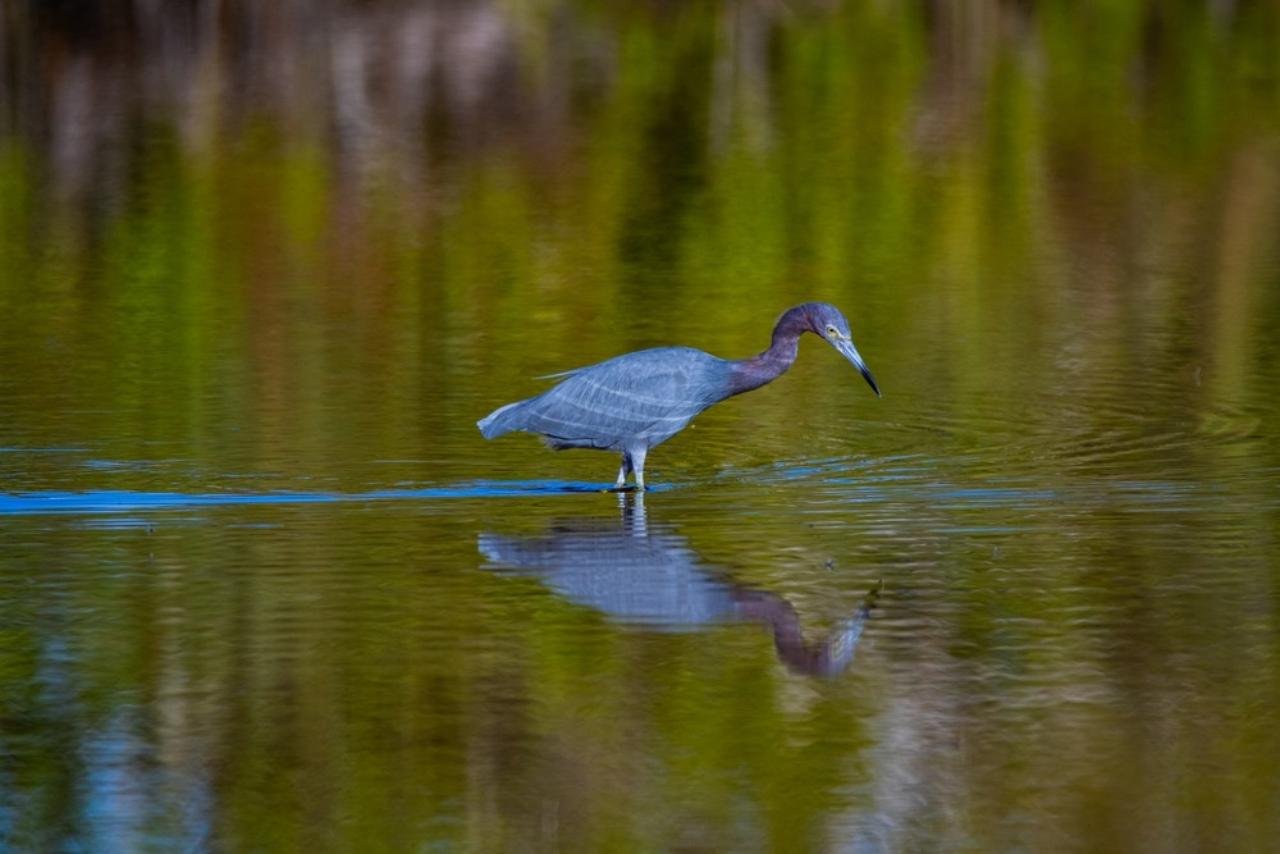
Areas where wading birds, including herons and egrets, frequently congregate
Kayaking offers an intimate, silent immersion in the wilderness, while the airboat experience provides a high-speed, motorized adventure across the marsh. Selecting the right everglades mangrove kayak tour tours depends on whether you prioritize quiet observation or thrill-seeking pace.
| Feature | Top pick Mangrove Kayak Tour | Airboat Tour |
|---|---|---|
Sound level |
Silent | High (engine noise) |
Wildlife interaction style |
Passive and observant | Distanced and fast-paced |
Physical exertion |
Moderate paddling required | None (passive seating) |
Accessibility |
Requires physical fitness | Easy for all ages |
Ability to enter narrow mangrove tunnels |
High capability | None (restricted to open water) |
Perspective of ecosystem |
Low-level and detailed | Panoramic and expansive |
| See tickets → |
Verdict: Choose the everglades mangrove kayak tour for deep engagement with the landscape or an airboat excursion for a broad, efficient overview of the wetlands. For those seeking everglades mangrove kayak tour tickets, early arrival is recommended to ensure the best wildlife sightings.
Choose your ticket, select your date, and reserve in under two minutes. Secure checkout handled by our verified partner.
Instant confirmation by email, with a mobile voucher you can save offline. No printing, no queuing at a collection desk.
Arrive at the entrance, show your voucher on your phone, and walk in. Most tickets include priority or skip-the-line access.
Practical details for your visit straight from our verified partners — hours, access, rules, and how to get there.
40001 State Road 9336, Homestead, FL 33034
Primary registration point for tours
Follow Florida's Turnpike south to US 1 until reaching Homestead, then turn onto State Road 9336.
Wear moisture-wicking synthetic clothing and a wide-brimmed hat to protect against the Florida sun. Water shoes or secure sandals are essential for an everglades mangrove kayak tour.
Keep belongings in a dry bag to protect against water exposure during your everglades mangrove kayak tour. Large backpacks are discouraged as they interfere with paddling mobility.
Waterproof cameras or action cameras are recommended for capturing the everglades mangrove kayak tour. Use a floating wrist strap to prevent losing your device in the water.
Kayaking requires the ability to enter and exit a low-profile boat from a dock or shoreline. Those with mobility limitations should inquire about adaptive everglades mangrove kayak tour options in advance.
Keep mobile phones in a sealed, waterproof case during the everglades mangrove kayak tour. Cell service can be unreliable in deeper sections of the park.
Children under age 12 must wear a life jacket at all times during the everglades mangrove kayak tour. Guardians should assess paddling stamina before booking multi-hour excursions.
Bring sufficient water to stay hydrated during your everglades mangrove kayak tour. Pack light, non-perishable snacks, and carry all trash out with you to maintain park cleanliness.
Pets are prohibited on the water and in the backcountry during any everglades mangrove kayak tour. Service animals must be documented and are subject to specific park regulations.
Always follow the instructions of your guide to protect the delicate root systems. Respect wildlife distance guidelines during every everglades mangrove kayak tour.
40001 State Road 9336, Homestead, FL 33034
Primary registration point for tours
Get directionsBest time to go, insider tips, nearby landmarks, and the cancellation fine print — flip through to skim what matters to you.
How crowds, weather, and events shift across the year.
Cool, dry weather and peak bird activity from December to March.
Warm temperatures with decreasing humidity through May.
High humidity and temperatures, but quiet trails; best for early morning tours.
Transition season with occasional storm activity.
Small details that turn a good visit into a great one.
Apply sunscreen 20 minutes before starting your everglades mangrove kayak tour. Reapply frequently due to water reflection.
Maintain a distance of at least 15 feet from alligators. Never attempt to touch or feed local fauna.
Book the earliest everglades mangrove kayak tour slot to beat the heat. Wildlife is most active during the morning hours.
Ensure all electronics are stored in a dry bag for the duration of the everglades mangrove kayak tour. Water splash is inevitable in narrow channels.
Stick to marked paddling trails. The mangrove maze can be disorienting without proper guidance.
Non-bookable sights within a short walk — free to visit, easy to pair.
Features a boardwalk over a sawgrass marsh with frequent alligator sightings.
Provides a panoramic view of the river of grass.
Central hub for trailheads and wildlife education.
Flexible, no hidden fees.
Cancellations must be made at least 24 hours in advance for a full refund. The 35 USD entrance fee is collected per private vehicle upon park entry.
Hand-picked options within walking distance — pick a district for vibe, or a specific hotel for convenience.
Range of standard hotel options near the park entrance.
Local lodging options located near the park boundaries.
The mangrove forests of Everglades National Park contain more than 220,000 acres of red, black, and white mangrove species, forming the largest contiguous stand of protected mangroves in the western hemisphere. These salt-tolerant trees build land from water, their prop roots and pneumatophores trapping sediment and stabilizing coastline against storm surge. The tunnels that wind through them are not trails but tidal creeks, carved and widened over centuries by the twice-daily push and pull of Florida Bay. Established in 1947, Everglades National Park was the first American park created to protect an ecosystem rather than a scenic landmark. The mangrove estuaries serve as nurseries for juvenile tarpon, snook, and goliath grouper, and as feeding corridors for wading birds including roseate spoonbills, tricolored herons, and great egrets. During the dry season, November through April, wildlife concentrates along the remaining waterways, bringing predator and prey into close quarters. In summer, higher water disperses animals across the broader landscape, but the mangrove shade offers relief from midday heat that reaches ninety degrees by late morning. The Turner River, Halfway Creek, and Nine Mile Pond represent three of the park's most-paddled routes, each threading through mangrove tunnels so narrow that branches scrape both sides of a kayak at once. The canopy overhead closes to a lattice, filtering sunlight into coins of white on dark water. Roots descend in curtains. At high tide, paddlers glide beneath arches; at low tide, oyster bars emerge along the bends, their shells testament to the brackish salinity that defines this transition zone between freshwater Everglades and salt water of the Gulf. Mangrove ecosystems sequester carbon at rates up to four times higher than terrestrial forests, storing it in both biomass and the anaerobic peat below. The Everglades mangrove system alone holds an estimated 24 million metric tons of carbon. These forests also attenuate wave energy, reducing coastal erosion and buffering inland areas during hurricanes. Red mangroves, identified by their arching prop roots, colonize the outermost edge. Black mangroves, with finger-like breathing roots, occupy slightly higher ground. White mangroves grow furthest inland, lacking visible aerial roots but tolerating the highest salinity. Together, the three species form a gradient that mirrors the tidal and salinity zones of the estuary, a living architecture shaped by water and salt.

"The mangrove tunnels are not trails but tidal creeks, carved and widened over centuries by the twice-daily push and pull of Florida Bay."
A step-by-step walkthrough of the visit — what you'll see, how long each stage takes, and the details that matter.
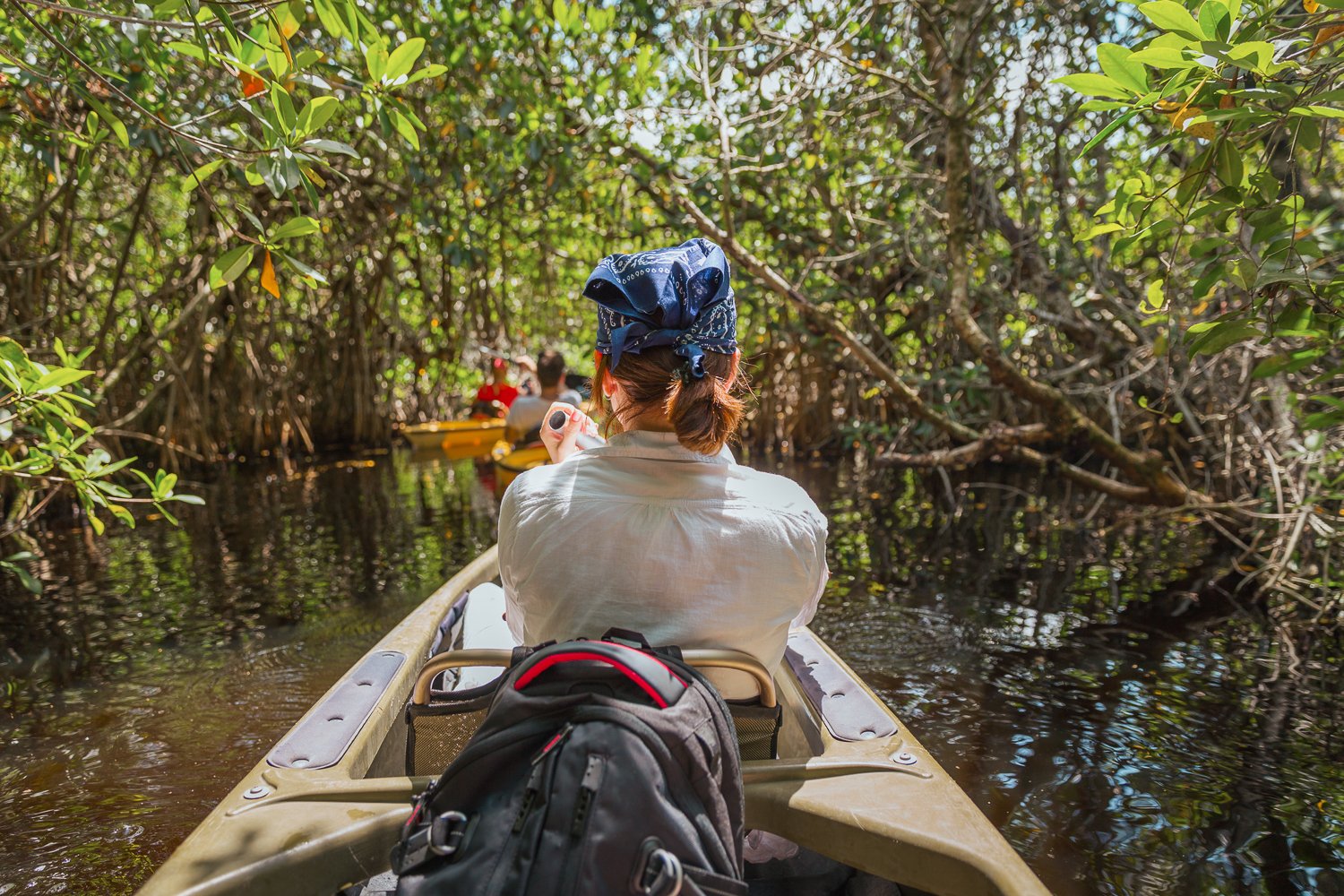
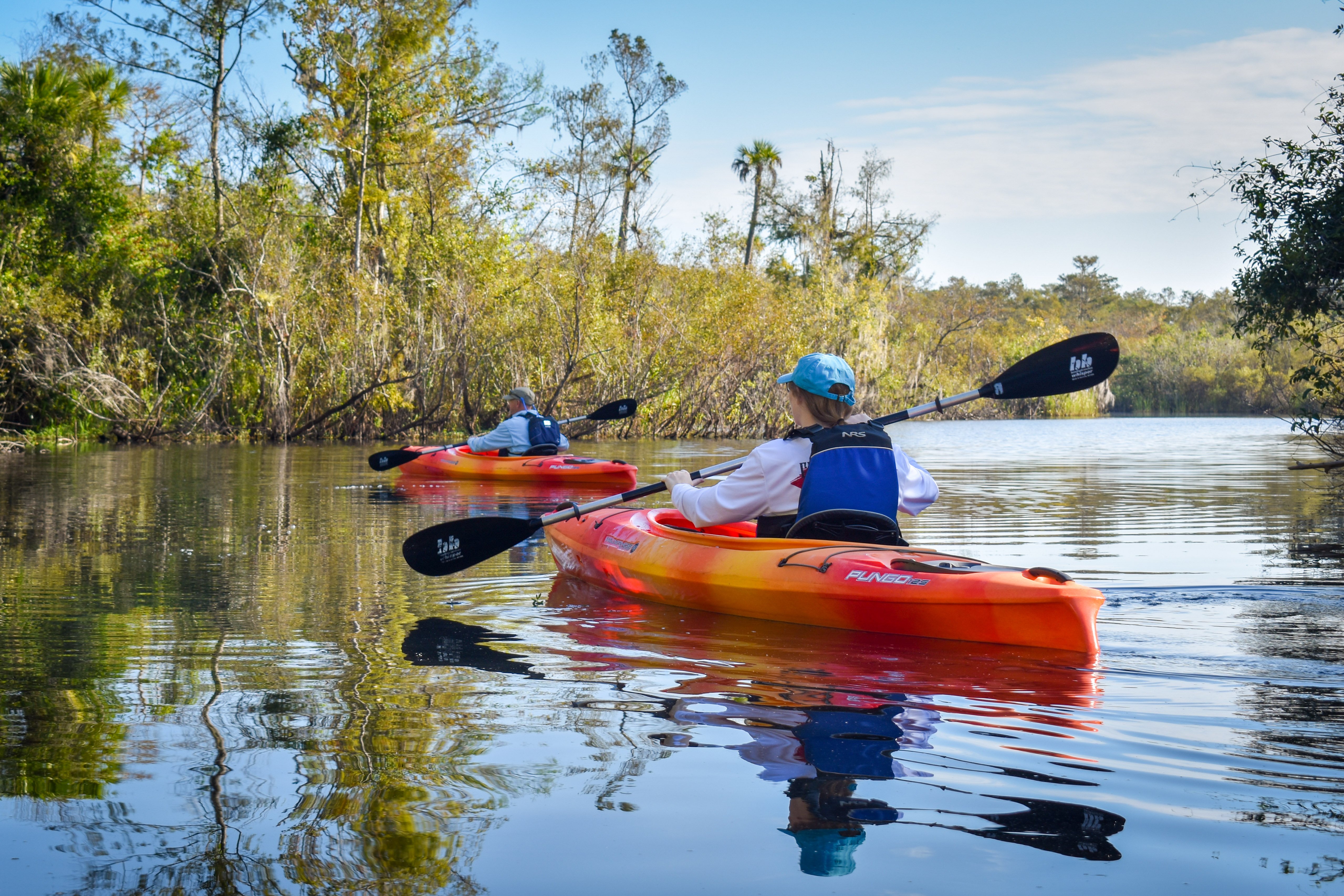
You launch from the sandy put-in near the ranger station, paddle resting across the cockpit while you adjust the footpegs and secure your dry bag. The water is tea-colored, stained by tannins leached from mangrove leaves. Within two hundred yards, the channel narrows and the first low arch appears, branches meeting overhead in a tangle of green. You duck and push through. Inside the tunnel, the light shifts. Sunlight fractures into a moving pattern on the surface. Prop roots descend on both sides, some as thick as your forearm, others thin as rope. You hear a splash to your left—a mullet breaking the surface, or perhaps a small tarpon. The naturalist guide ahead raises a hand and points silently to a mangrove crab clinging to a root at eye level, its purple-blue claw folded against its carapace. You drift closer, paddle blade dripping, and the crab retreats into a crevice. The tunnel bends, then opens into a small basin where the canopy pulls back and you see sky. A green heron stands motionless on a snag, neck coiled. The guide explains that this basin floods entirely at spring tide, submerging the oyster bar now visible along the southern edge. You paddle across, feeling the current shift as the tide begins to ebb, and enter the next tunnel, darker and tighter than the first.
Everglades National Park is open Monday through Sunday, 00:00–23:59. Specific activity hours may depend on your booked guide.
Yes, the entrance fee is 35 USD per private vehicle, valid for 7 consecutive days.
The best arrival window is 07:00–10:00 for the best wildlife activity and lower humidity.
Children must be able to wear a PFD; check specific operator requirements for your everglades mangrove kayak tour.
Bring sunscreen, water, insect repellent, and a dry bag for your everglades mangrove kayak tour.
Yes, but keep it in a waterproof case during the everglades mangrove kayak tour to prevent water damage.
Check the product grid on this page for available everglades mangrove kayak tour tickets.
Cancellations for an everglades mangrove kayak tour require 24-hour notice for a full refund.
Items like single-use plastics, alcohol, and drones are prohibited on all everglades mangrove kayak tours.
The address is 40001 State Road 9336, Homestead, FL 33034, accessible by car.